Reproducible extracellular vesicle isolation and DIA mass spectrometry workflows
Biomarker results are only as reliable as the methods behind them. EVs are a small fraction of what is in plasma, so how they are isolated, stored and measured has a large effect on what is found.
This work develops and benchmarks the workflows that the other projects depend on:
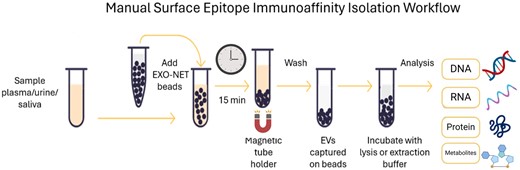
Isolation. High-throughput immunoaffinity isolation of EVs that is compatible with clinical laboratory automation (Khanabdali et al., 2024), and storage conditions that preserve EVs (Walker et al., 2022). I contributed to the community MISEV2023 reporting guidelines (Welsh et al., 2024).
Mass spectrometry. Data-independent acquisition (DIA) proteomics on Orbitrap Astral and ZenoTOF 7600 platforms, from early SWATH-MS studies (Jayabalan et al., 2019) to deep profiling of blood components and their EVs (Hwang et al., 2024), alongside targeted assays for placental EVs (Lai et al., 2022).
Data analysis. Pipelines that take raw DIA data through to candidate biomarkers, run on high-performance computing for large multi-site cohorts.
References
2024
Biol Methods Protoc
High throughput Surface Epitope Immunoaffinity Isolation of Extracellular Vesicles and Downstream Analysis
Ramin Khanabdali, Michelle Mandrekar, Rick Grygiel, Phuoc-An Vo, and 18 more authors
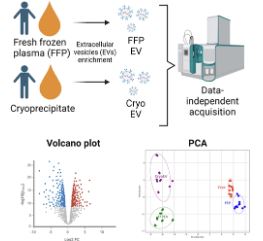
Proteomic Characterization of Transfusable Blood Components: Fresh Frozen Plasma, Cryoprecipitate, and Derived Extracellular Vesicles via Data-Independent Mass Spectrometry
Ji Hui Hwang, Andrew Lai, John-Paul Tung, Damien G Harkin, and 2 more authors
Quantitative proteomics by SWATH‐MS suggest an association between circulating exosomes and maternal metabolic changes in gestational diabetes mellitus
Nanthini Jayabalan, Andrew Lai, Soumyalekshmi Nair, Dominic Guanzon, and 5 more authors